
Why Getting Your EQ Assessed Is Not a Soft Skill Exercise
She's a good manager by every visible metric.
Her team trusts her. She stays late when they're overwhelmed. She redistributes work when someone is struggling. She doesn't push people into stretch assignments because she doesn't want to stress them out.
Her team likes her. But they aren't growing. The better people are starting to look around.
She's not a bad manager. She has too much of something everyone told her was unequivocally good. She has high empathy, and she has no idea it's working against her.
This is the problem with treating emotional intelligence as a personal virtue rather than a set of measurable, coachable capacities. You can't develop what you can't see. And most managers are operating on assumption rather than data.
The research is not subtle on this.
A study of more than 5,000 managers found that the relationship between empathy and team productivity is not linear. Highly empathetic managers were actually more likely to undermine team performance than managers who lacked empathy altogether. The mechanism: they tended to shield people from difficult work, delegate less, and carry more than they should. Protective behavior that looked like care was functioning as a trust deficit.
Research from O.C. Tanner's 2025 Global Culture Report adds another layer. Managers with high EQ retain 70% of their employees for five years or more. Leaders with high EQ are 40 times more likely to handle conflict effectively. When employees perceive their leader as having high EQ, there is a 44-times increase in the likelihood they'll also perceive the organization as having high integrity.
The business case exists. But the case for measuring EQ rather than just aspiring to it is what most organizations miss.
What the EQ-i 2.0 actually does.
The EQ-i 2.0 is the most widely used and rigorously validated measure of emotional intelligence available. Developed from Reuven Bar-On's original research model and published by Multi-Health Systems, it has been validated across industries, countries, and leadership levels over decades.
It does not measure personality. It does not measure potential. It measures how you are currently using emotional and social functioning across 15 specific subscales, organized into five composites: Self-Perception, Self-Expression, Interpersonal, Decision Making, and Stress Management.
That distinction matters for analytical leaders especially. This is not a quiz. It is a snapshot of your current functioning, with enough specificity to tell you exactly where the imbalances are.
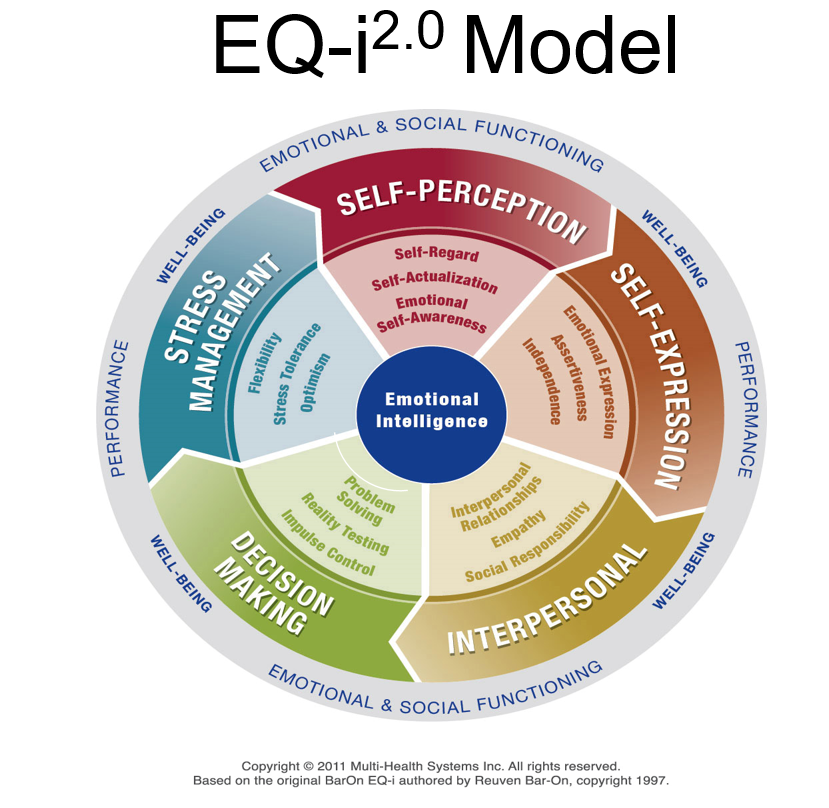
The EQ-i 2.0 Model
A leader might score high on Empathy and low on Assertiveness. That combination produces a very specific type of people management failure: listening without acting, absorbing team problems without solving them, avoiding hard conversations until they become crises. You cannot get to that diagnosis through reflection alone. You need data.
The Double Skills Gap is partly an EQ measurement problem.
I work with technically strong managers at growing companies who were promoted because they were excellent individual contributors. They did not fail at the technical work. They failed at the transition, and nobody saw it coming because nobody measured for it.
The assessment creates the first honest conversation. Not "what do you think you need to work on" but "here is what the data shows about how you are currently operating under pressure, in relationships, and when making decisions." For analytical minds, that framing lands. They can work with a profile. They struggle with vague feedback like "you need to be more empathetic."
EQ can be developed. That's the whole point.
Unlike IQ, emotional intelligence is not fixed. As Daniel Goleman has noted, it continues to develop as people learn from experience. The EQ-i 2.0 assessment is not a verdict. It is a starting point.
What it provides is specificity. Most leadership development fails because it teaches concepts without giving people a personalized map of where they actually are. The assessment changes that. It shows leaders not just what EQ is, but where their current patterns are serving them and where those same patterns are creating invisible friction.
Back to the manager at the start of this post. When she sees her own profile, she doesn't see "you lack empathy." She sees a picture of a leader who has high empathy running unchecked by sufficient assertiveness and independence. She sees, in data, the exact mechanism by which her care is creating dependency rather than capability.
That conversation is where development actually starts.
If you are watching a technically strong person struggle in a people leadership role, the question is not whether EQ matters. The research settled that. The question is whether you are giving them a precise enough picture to actually change.